
Inverter Pool Heat Pumps Cape Town, sized and installed in all areas in The Western Cape
Heat your pool all year, day and night, in sun or cloud.
Pool Heat Pumps Cape Town
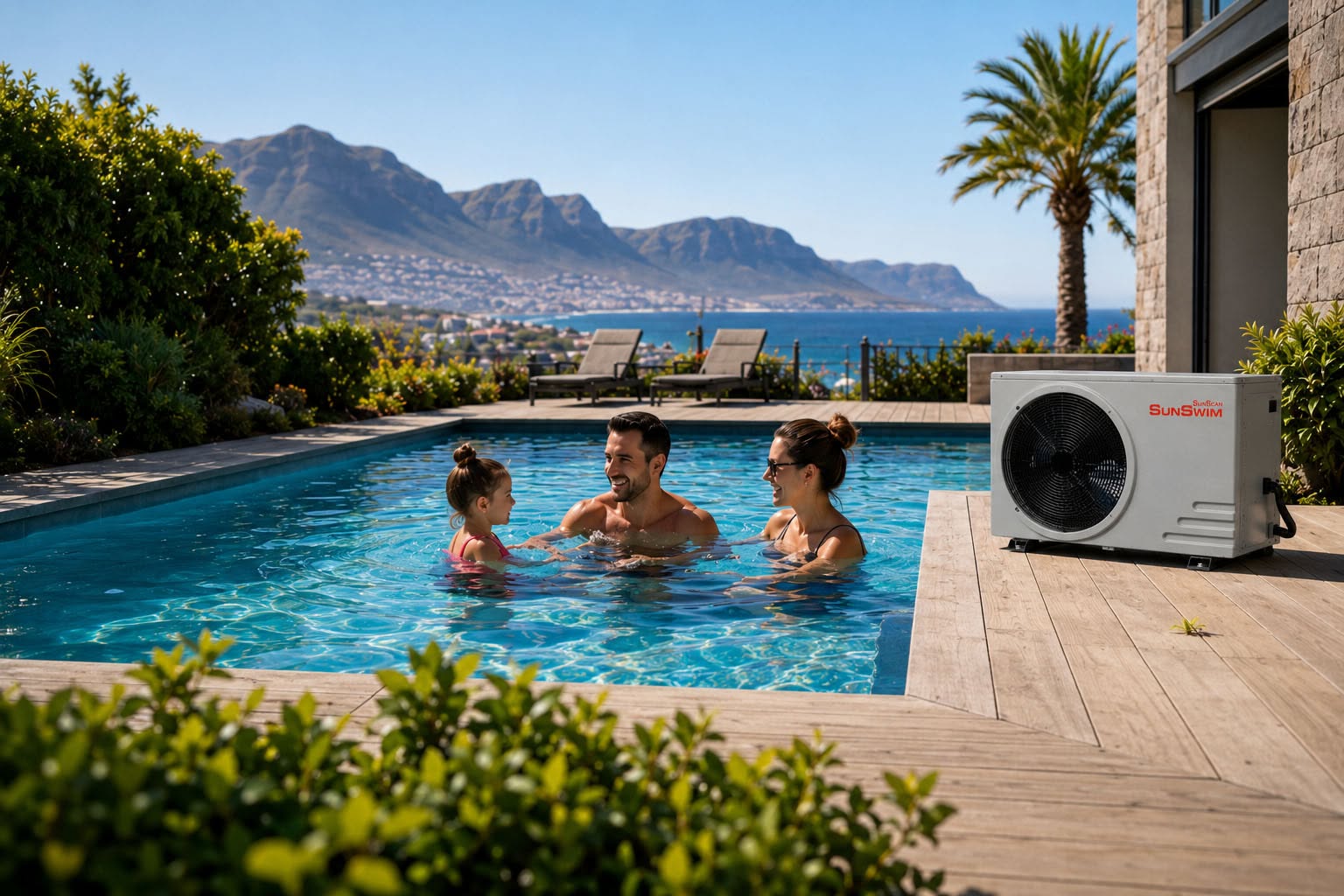
Pool heat pumps are the most efficient way to heat a swimming pool through a Cape Town winter. A heat pump takes warmth from the outside air and moves it into your pool water. It runs at night, in cloud and in rain, so it does not depend on sunshine.
Solar Ingenuity supplies, sizes and installs inverter pool heat pumps from 7.6 kW to 28 kW across Cape Town and the Western Cape. We are a family owned business based in Sunningdale, and we have worked in solar and pool heating since 2001. Every job starts with a free sizing assessment, so you buy the unit your pool needs and not the one that is easiest to sell.
Get a free sizing and quote WhatsApp Mark: 067 056 5131
Which pool heat pump do you need?
Match the unit to your pool volume. With a thermal cover on the pool, a 7.6 kW unit suits pools up to 38,000 litres, a 10 kW unit up to 50,000 litres, a 13 kW unit up to 65,000 litres, a 17 kW unit up to 85,000 litres, a 21 kW unit up to 100,000 litres and a 28 kW unit up to 130,000 litres. Without a cover the pool loses more heat, so the right size can be larger. We confirm the final size on site.
How a pool heat pump works
A fan draws outside air across an evaporator coil. The refrigerant inside the coil warms and turns into a gas. A compressor squeezes the gas, which raises its temperature further. Your pool water passes through a titanium heat exchanger and takes the heat from the gas. The warm water returns to the pool, and the refrigerant cools and starts the cycle again.
The unit moves heat and does not make it. That is why one kilowatt of electricity can deliver several kilowatts of heating. An electric element can only turn one kilowatt of electricity into one kilowatt of heat.
Why inverter pool heat pumps suit Cape Town pools
A standard pool heat pump has a compressor that is either on or off. An inverter pool heat pump changes the compressor speed to match what the pool needs. It runs fast to bring the water up to temperature, then slows down to hold it there. SunScan, the maker of the SunSwim range we install, states that its inverter units use up to 50% less energy than standard on/off pool heat pumps.
Efficiency is measured as COP, the heat you get for each unit of electricity you put in. On the SunSwim specification sheet, the 10 kW unit shows a COP of 7.02 at full output and 14.68 at its lowest speed when the air is 26°C. On a cooler day with 15°C air, the same unit shows a COP of 4.95 at full output and 7.58 at its lowest speed. In plain terms, each 1 kW of electricity delivers about 5 to 7.5 kW of heat in cool weather.
Inverter units also start gently. A standard unit draws a large current when its compressor starts, which strains your electrical supply. A SunSwim unit ramps up slowly, so it places less load on your supply and is easier to add to a home with solar PV.
The units suit coastal conditions. The heat exchanger is titanium, which resists salt, chlorine and pool chemicals. The casing is rust proof ABS plastic. The refrigerant is R32. The units work in outside air from minus 15°C to 43°C, and they can cool the pool on very hot days as well as heat it. A WiFi app lets you set the temperature, check the unit and change settings from your phone. The 7.6 kW and 10 kW units are rated at 43 dB or less, and the 17 kW unit at 46 dB or less.
Pool heat pump sizing guide
SunScan sizes the SunSwim range by pool volume with a thermal cover fitted. Use the table below as a starting point.
| Model | Heating capacity | Pool size with thermal cover | Suited to |
|---|---|---|---|
| SSP-INV007 | 7.6 kW | Up to 38,000 L | Plunge pools, jacuzzis and small pools |
| SSP-INV010 | 10 kW | Up to 50,000 L | Medium pools |
| SSP-INV013 | 13 kW | Up to 65,000 L | Family pools |
| SSP-INV017 | 17 kW | Up to 85,000 L | Large family pools |
| SSP-INV021 | 21 kW | Up to 100,000 L | Large residential pools |
| SSP-INV028 | 28 kW | Up to 130,000 L | Extra large residential and commercial pools |
How to work out your pool volume
Multiply the length by the width by the average depth, all in metres, then multiply by 1,000 to get litres. A pool that is 8 m long, 4 m wide and 1.5 m deep on average holds 48 cubic metres, which is 48,000 litres. That pool sits within the 10 kW range of up to 50,000 litres.
What changes the size you need
Six things move the answer: pool volume, whether you use a thermal cover, wind exposure, shade, the water temperature you want and the months you want to swim. A pool in a windy position without a cover loses heat quickly and needs a bigger unit than the same pool with a cover in a sheltered garden. An undersized unit runs flat out for longer, takes more days to heat the pool and costs more to run. We look at all six at your free on-site assessment.
SunSwim inverter pool heat pump specifications
These figures come from the SunScan specification sheets. Outputs and COP are measured at air 26°C with 80% humidity, and at air 15°C with 70% humidity, with pool water entering at 26°C and leaving at 28°C. We can supply the full specification sheets for the 13 kW, 21 kW and 28 kW units on request.
| Specification | SSP-INV007 (7.6 kW) | SSP-INV010 (10 kW) | SSP-INV017 (17 kW) |
|---|---|---|---|
| Maximum pool size with thermal cover | 38,000 L | 50,000 L | 85,000 L |
| Maximum heating output, air 26°C | 7.62 kW | 10.21 kW | 16.52 kW |
| COP, air 26°C (full output to lowest speed) | 6.91 to 14.52 | 7.02 to 14.68 | 7.23 to 15.17 |
| Maximum heating output, air 15°C | 5.74 kW | 7.62 kW | 12.61 kW |
| COP, air 15°C (full output to lowest speed) | 4.94 to 7.53 | 4.95 to 7.58 | 4.96 to 7.61 |
| Power input at full output, air 15°C | 1.16 kW | 1.54 kW | 2.54 kW |
| Rated current | 5.27 A | 7 A | 11.55 A |
| Power supply | 230 V, single phase, 50 Hz | 230 V, single phase, 50 Hz | 230 V, single phase, 50 Hz |
| Refrigerant | R32, 380 g | R32, 460 g | R32, 850 g |
| Heat exchanger | Titanium | Titanium | Titanium |
| Water flow | 2.5 m3/h | 3.5 m3/h | 5.5 m3/h |
| Noise level | 43 dB or less | 43 dB or less | 46 dB or less |
| Air temperature working range | Minus 15°C to 43°C | Minus 15°C to 43°C | Minus 15°C to 43°C |
| Defrost | Four way valve | Four way valve | Four way valve |
| Size (L x W x H) | 836 x 379 x 591 mm | 836 x 379 x 591 mm | 896 x 389 x 641 mm |
| Net weight | 42 kg | 43 kg | 54 kg |
| Casing | Rust proof ABS plastic | Rust proof ABS plastic | Rust proof ABS plastic |
Pool heat pumps, solar pool panels or electric heaters
The right choice depends on how many months you want to swim and how much you want to spend each month.
| Inverter pool heat pump | Solar pool heating panels | Electric element heater | |
|---|---|---|---|
| Swimming season | All year | About October to April | All year |
| Weather | Runs day and night, in cloud and in rain | Needs direct sunshine | Runs in any weather |
| Efficiency | COP of about 5 to 7.5 on a 15°C day (SunSwim specifications) | No heating electricity cost, only the circulation pump | COP of 1, so 1 kW in gives 1 kW of heat |
| Temperature control | Digital thermostat and WiFi app | Depends on the sun hours each day | Thermostat, but costly to run |
Many Cape Town owners use both a heat pump and panels. The panels heat the pool free of charge on sunny days from spring to autumn. The heat pump takes over in cloud and winter. If you want to compare the two in detail, read about our solar pool heating panels.
How long does a pool heat pump take to heat a pool?
SunScan states that the first heat up can take up to 84 hours in the worst case to raise a pool by 8 to 10°C. The time depends on the unit size, the pool volume, the air temperature and the wind. The pool surface and the ground around the pool also play a part. The cooler the air, the longer it takes.
After the first heat up, the unit only replaces the heat the pool loses, so it runs far less. Start before the swimming season, keep the thermal cover on overnight and set a temperature timer in the app.
What a pool heat pump costs to run
Look at the specification sheet for the 10 kW unit. On a 15°C day it draws up to 1.54 kW of electricity at full output and delivers up to 7.62 kW of heat. If your tariff is R3 per kWh, that is about R5 for each hour at full output. An electric element needs 7.62 kW of electricity to deliver the same heat, which is about R23 for each hour. Use your own tariff to work out your figure.
Once the pool reaches the temperature you set, the inverter slows down. At its lowest speed the 10 kW unit draws 0.23 kW at 15°C, which is under R1 for each hour at the same tariff. Your actual cost depends on the pool size, the cover, the weather and how many hours the unit runs. We give you an estimate with your quote.
Pool heat pumps and solar PV
SunSwim inverter units start gradually, so they draw less current at start up than standard on/off units. That makes them easier to add to a home that has solar PV. Whether your system can carry the heat pump depends on the size of the PV array, the size of the heat pump and the hours it runs. We check this at the assessment, so you know before you buy.
Pool heat pump installation in Cape Town
Solar Ingenuity looks after the whole job: sizing, supply, plumbing connection, electrical supply and setup. The unit needs its own electrical supply to run the fan and compressor. We choose a position close to the pool, because shorter pipe runs lose less heat on the way to the water. We also think about airflow around the unit and the noise at your boundary.
At handover we show you how the app and the settings work. Our work is covered by our installation guarantee. Read what our customers say from homeowners we have worked for.
Warranty and documents
SunScan lists warranty periods of 1 to 5 years on the SunSwim range. We send you the SunScan warranty document, the installation manual and the quick setup guide with your quote, so you can read the terms before you decide. You can also see the full range on the SunScan pool heat pump page.
Pool heat pump installation areas
We install across Cape Town and the Western Cape, including the Atlantic Seaboard, the Southern Suburbs, the Northern Suburbs, Blouberg, Table View, Durbanville, Bellville, the West Coast and the Winelands. See the full list of areas we serve. If your suburb is not listed, call us and ask.
Pool heat pump questions and answers
How does a pool heat pump work?
A fan pulls outside air over a coil that holds refrigerant. The refrigerant warms and becomes a gas. A compressor squeezes the gas and raises its temperature. Your pool water passes through a titanium heat exchanger and absorbs that heat, then returns to the pool. The unit moves heat from the air into the water and does not make heat itself, which is why it uses far less electricity than an element heater.
What size pool heat pump do I need?
Size the unit to your pool volume. With a thermal cover fitted, SunScan rates the 7.6 kW unit for pools up to 38,000 litres, the 10 kW for 50,000 litres, the 13 kW for 65,000 litres, the 17 kW for 85,000 litres, the 21 kW for 100,000 litres and the 28 kW for 130,000 litres. Wind, shade and the lack of a cover can push you to a larger unit. We confirm the size at a free on-site assessment.
How much does a pool heat pump cost in Cape Town?
The price depends on the unit size and the installation. SunScan places the 7.6 kW unit in its budget range, the 10 kW in the low range, the 13 kW and 17 kW in the mid range, and the 21 kW and 28 kW at the top of the range. We give you a written quote once we confirm your pool volume and see where the unit will stand. Request a free quote on 067 056 5131.
How much does a pool heat pump cost to run?
Running cost depends on the unit size, pool volume, cover and the hours the unit runs. On a 15°C day, the SunSwim 10 kW draws up to 1.54 kW of electricity while delivering up to 7.62 kW of heat. An electric element needs 7.62 kW of electricity for the same heat. Multiply the kilowatts by your tariff to see the hourly cost. Once the pool reaches temperature, the inverter slows down and the draw drops to as little as 0.23 kW on the 10 kW unit.
Can a pool heat pump heat my pool in winter?
Yes. The SunSwim units work in outside air from minus 15°C to 43°C. Output falls as the air cools. The 10 kW unit delivers up to 10.21 kW with 26°C air and up to 7.62 kW with 15°C air. In winter, a thermal cover and correct sizing matter most, because they decide how much heat the pool keeps overnight.
Does a pool heat pump work at night and when it is cloudy?
Yes. A pool heat pump takes heat from the air and does not need direct sunlight. It runs day and night, in cloud and in rain. Solar pool panels need sunshine, which is why many Cape Town owners add a heat pump for winter.
How long does it take to heat a pool with a heat pump?
The first heat up depends on the unit size, pool volume, air temperature and wind. SunScan states that it can take up to 84 hours in the worst case to raise a pool by 8 to 10°C. After that, the unit only has to replace the heat the pool loses. Start before the swimming season and keep the cover on to shorten the first heat up.
Are pool heat pumps noisy?
The SunSwim 7.6 kW and 10 kW units are rated at 43 dB or less, and the 17 kW unit at 46 dB or less. We think about noise when we choose where the unit stands, and we keep the pipe run to the pool short.
Do pool heat pumps work with salt water pools?
Yes. SunScan builds its pool heat pumps with titanium heat exchangers, which suit most pool water types including salt water pools. Titanium resists corrosion from salt and pool chemicals.
Can I run a pool heat pump on solar PV?
Often yes. Inverter units start gradually and draw less current at start up than standard on/off units, so they suit homes with solar PV. Whether your system can carry the unit depends on the size of your PV system, the size of the heat pump and the hours it runs. We check this at the assessment.
What is the difference between an inverter and a standard pool heat pump?
A standard on/off unit runs its compressor at one speed and draws a large current when it starts. An inverter unit changes its compressor speed to suit the conditions and starts gradually. SunScan states that its inverter units use up to 50% less energy than standard on/off units and run about four times more efficiently on average.
Can I combine a pool heat pump with solar pool panels?
Yes. Many Cape Town pools use both. The panels do the work on sunny days and the heat pump takes over in cloud and in winter. Read more about solar pool heating panels.
Which areas do you install pool heat pumps in?
We install across Cape Town and the Western Cape, including the Atlantic Seaboard, Southern Suburbs, Northern Suburbs, Blouberg, Table View, Durbanville, Bellville, the West Coast and the Winelands. See the full list of areas we serve.
Get your free pool heat pump sizing and quote
Tell us your pool size, whether it has a cover and where you want the unit. Mark will confirm the right size and send you a written quote. You can also book a free on-site assessment.
Request a free quote WhatsApp Mark: 067 056 5131
Mark (direct and WhatsApp): 067 056 5131
Office: 021 554 1717
Email: sales@solaringenuity.co.za
Address: Oakland Hill Rd, Sunningdale, Cape Town, 7441
Looking for a hot water solution as well? See our solar geysers.
Last updated: 28 October 2026. Specifications are from SunScan SunSwim data sheets and may change.